
Reviewed · HISTORICAL TOURS
Kuala Lumpur Colonial History Walk – Private Guided Tour
Colonial Kuala Lumpur rewards curious walkers. I like the private format, which keeps the pace and conversation focused on your group, and I like the way grand buildings are tied to local stories rather than treated as photo stops. Guides such as Priam and Pritam have been praised for clear storytelling and personal care.
The main consideration is physical: this is a 3 to 4-hour walk in a warm city, with many outdoor stops and no bottled water included. At $45 per person, it is good value for up to four people, but less so for a solo visitor on a tight budget.
In This Review
- Key points worth knowing
- Why this Kuala Lumpur walk feels different
- Beginning beneath the domes of Kuala Lumpur Railway Station
- The railway offices and the machinery of administration
- The Klang River and the city’s starting point
- Old Market Square and a coronation clock
- Jamek Mosque at the Klang and Gombak confluence
- Sultan Abdul Samad Building and the colonial civic center
- St. Mary’s Cathedral and the Selangor Club
- The former Government Printing Office and Kuala Lumpur Library
- The old Chartered Bank and Queen Victoria Fountain
- Central Market makes a practical final stop
- What $45 per person really buys you
- Timing, fitness, and practical details
- Who should book this walk
- Should you book the Kuala Lumpur Colonial History Walk?
- FAQ
- How long does the tour last?
- Where does the tour begin?
- Where does the tour end?
- Is this a private tour?
- What is included in the price?
- Are meals included?
- Is bottled water provided?
- Is the tour near public transportation?
- What level of fitness is required?
- Can I cancel for a full refund?
Key points worth knowing

- Start at Kuala Lumpur Railway Station: The tour opens with one of the city’s most striking white buildings, then links it to the railway system that helped shape modern Malaya.
- A private group of up to four: You get room to ask questions and adjust the pace without being folded into a large commercial group.
- Colonial buildings meet local stories: The route covers government offices, churches, mosques, markets, railway buildings, and river geography.
- Central Market is the final stop: The 30-minute visit gives you an easy place to continue exploring, shop, eat, or catch public transport.
- Mostly free outdoor sights: There are no major admission charges along the route, though meals and bottled water are your responsibility.
- Book ahead: The experience is commonly reserved about 30 days before the date, so last-minute availability may be limited.
Why this Kuala Lumpur walk feels different
Kuala Lumpur’s colonial center is compact, but it is easy to miss the connections between its buildings. A white railway station can seem like a grand piece of architecture. A clock tower can look like a simple city ornament. A mosque can appear to be an isolated landmark. This walk gives you the links between them.
The route tells the story of a city shaped by rivers, mining, railways, administration, trade, and several religious communities. You move through a relatively small central area, yet the subjects keep changing. That variety is the main strength of the experience.
I also like the scale of the tour. It is designed for a private party of up to four people, which is small enough for a natural conversation. You can ask why a building looks the way it does, pause for a photograph, or request more detail about a particular subject without competing with a busload of people.
The tone is intended to be personal and story-led. That matters in Kuala Lumpur, where formal colonial buildings can otherwise feel detached from the city around them. The guide’s job is not simply to name dates. It is to explain how these places fit together.
More Historical Tours in Kuala Lumpur
- Historical Malacca Guided Day Tour (Shared Tour)
★ 5.0 · 2,172 reviews - Kuala Lumpur: Batu Caves & Historic Buildings Tour
★ 4.7 · 539 reviews - Historical Malacca Day Tour from Kuala Lumpur (Private Tour)
★ 5.0 · 515 reviews
Beginning beneath the domes of Kuala Lumpur Railway Station
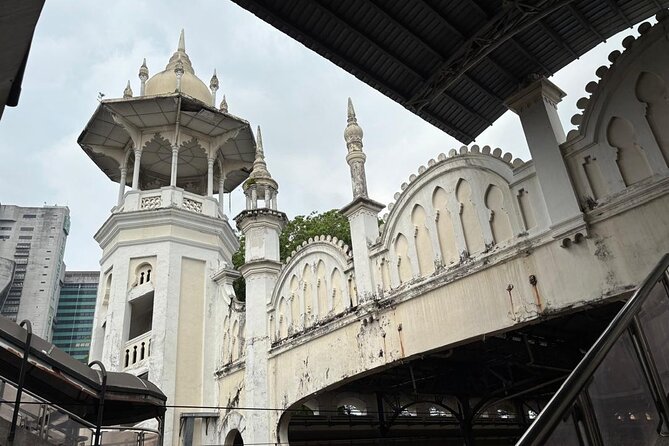
The tour starts at Kuala Lumpur Railway Station on Jalan Sultan Hishamuddin. Allow about 15 minutes here, although the building deserves more than a rushed glance.
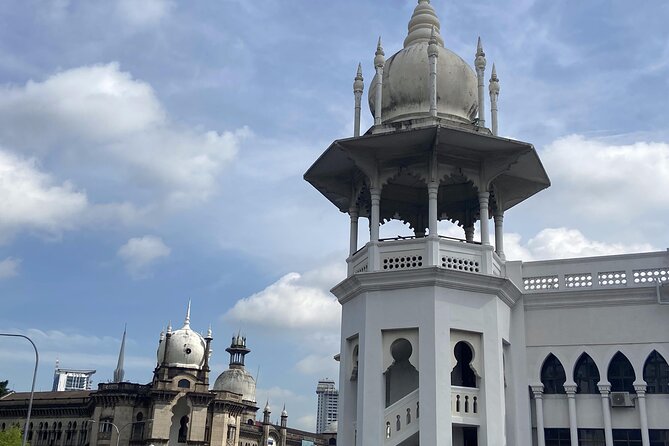
Its white exterior, domes, arches, and minaret-like forms give it a fanciful appearance. It looks almost too decorative for a railway station, which is exactly why it makes such a strong opening point. The building captures the old colonial taste for grand public architecture, while its purpose points to something more practical: rail travel changed how people and goods moved through the region.
You will not be charged an admission fee at this stop. The value comes from having the architecture explained instead of merely photographed. Your guide can help you notice the building’s repeated arches, pale surfaces, and unusual blend of design influences.
The station is also a useful reminder that Kuala Lumpur’s past was not built only through government offices. Transport was part of the city’s growth, and the railway gave colonial administration and commerce a wider reach.
The railway offices and the machinery of administration
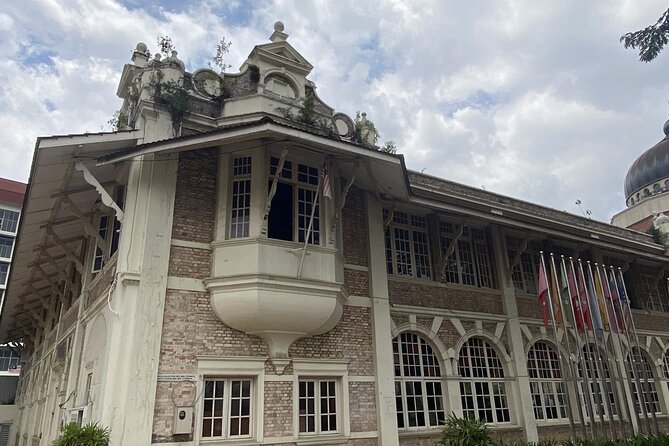
Across from the station is the Malayan Railway Administration Building, planned by Government Architect Arthur Benison Hubback. The stop takes about 10 minutes and remains outside, so comfortable shoes and protection from the sun are sensible.
Construction began in 1914, three years after the station. Seeing the two buildings together helps you compare their roles. One served the public as a transport gateway. The other housed the administration behind the railway system.
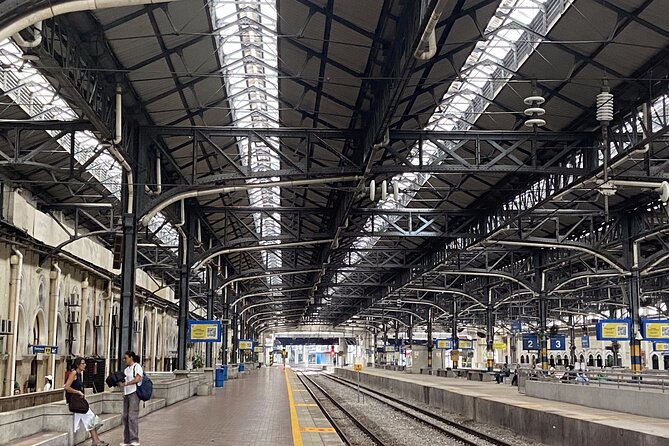
The route later returns to railway history at the Old FMS Railway Office. This was the first headquarters of the Federated Malay States Railways, created as separate state systems moved toward a unified network. Malaya’s first railway line opened in 1885 between Taiping and Port Weld.
I find this pairing especially useful. Instead of hearing one isolated fact about a railway building, you see the system’s public face and administrative side. The story becomes about infrastructure and power, not just attractive facades.
The Klang River and the city’s starting point
The walk also brings you to the Klang River, Selangor’s longest river at about 120 kilometers. It rises near the Klang Gates Quartz Ridge in the Titiwangsa range, passes through Kuala Lumpur, and eventually reaches the Strait of Malacca.
The river matters because Kuala Lumpur’s name comes from the meeting of the muddy Klang and Gombak rivers. The Jamek Mosque sits at this confluence, often described as the birthplace of the city.
This is one of the more valuable parts of the route for first-time visitors. Modern Kuala Lumpur can feel like a city of towers and traffic, but the river junction explains the older settlement pattern. You are not just looking at a religious building. You are standing near the geographic reason the city developed where it did.
The river stop may be less visually polished than the grand colonial buildings. That is part of its usefulness. It connects the formal city center to the muddy, practical origins of Kuala Lumpur.
More Walking Tours in Kuala Lumpur
- Kuala Lumpur Local Street Food Private Walking Tour by Night
★ 4.5 · 224 reviews - Kuala Lumpur: Nightlife Walking Tour with Local Guide
★ 5.0 · 33 reviews - Half Day Cultural And Heritage Walking Tour in Kuala Lumpur
★ 5.0 · 28 reviews - Kuala Lumpur InfoFun Walking Tour Experience
★ 5.0 · 24 reviews
Old Market Square and a coronation clock
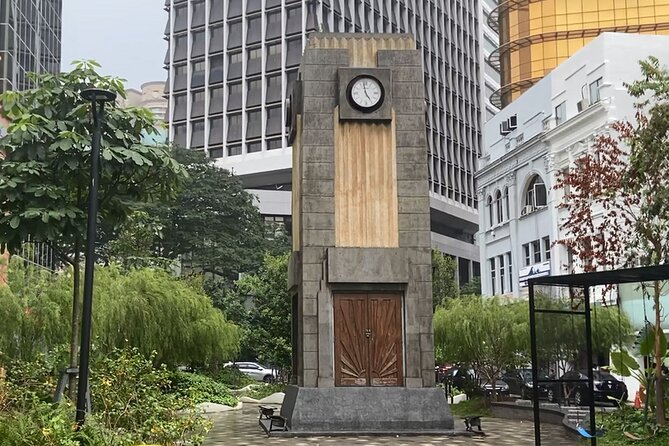
Old Market Square is marked by an elegant clock tower erected in 1937 for the coronation of King George VI. The stop lasts around 10 minutes and offers another example of how imperial events were represented in the city’s public spaces.
The tower was conceived by architect Arthur Oakley Coltman. Its presence gives the square a formal focal point, but the larger point is the way public architecture could carry political messages. A clock is useful, decorative, and symbolic all at once.
The guide’s explanation is important here because the tower alone does not tell you why it was built. With context, you can read the square as part of a colonial civic center, not simply as a convenient place to take a picture.
Jamek Mosque at the Klang and Gombak confluence
The Jamek Mosque receives about 15 minutes. Its location is the key. It sits where the Klang and Gombak rivers meet, at the point associated with Kuala Lumpur’s beginnings.
This stop brings an important change in tone. The route is not a parade of British offices and European institutions. The mosque places Islamic architecture and local urban identity at the center of the story.
You should expect to view the mosque as part of the city’s historic setting rather than as a long interior visit. The tour description does not promise an extended entry or a formal religious tour, so dress and conduct should be respectful.
For me, this is one of the stops that keeps the walk from becoming a narrow account of colonial administration. It shows that the city’s identity cannot be separated from its rivers, faith, and local communities.
Sultan Abdul Samad Building and the colonial civic center
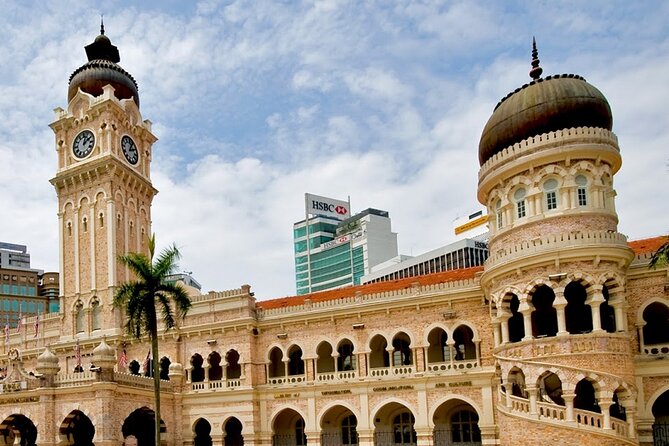
The Sultan Abdul Samad Building gets about 15 minutes, but you will likely want time to look across the surrounding area. Built in 1894 for the British colonial administration, it was part of a government complex that also included the former General Post Office, Magistrate Courts, and Kuala Lumpur Council Building.
Its towers, arches, and decorative details make it one of the most recognizable historic structures in the city. Yet its real importance comes from function. This was a center of government, where administration became visible in stone, brick, and carefully planned public space.
The building also helps explain the layout of the district. The nearby open field and related offices were not accidental groupings. They formed a civic stage for government, ceremonies, communication, and law.
A private guide can make this stop more useful by separating the buildings and explaining what each one did. Without that context, the whole group can blur into one grand facade.
St. Mary’s Cathedral and the Selangor Club
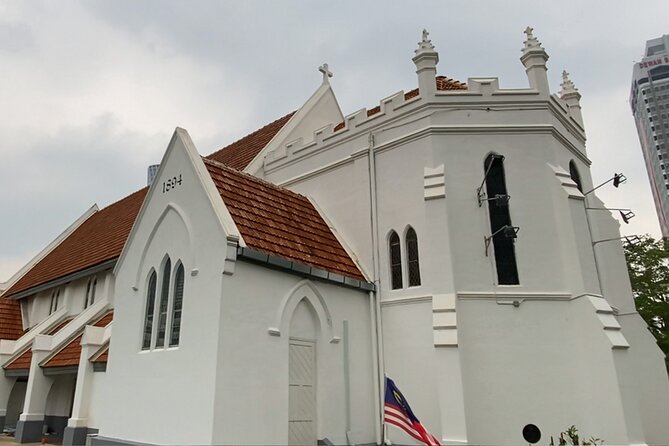
St. Mary’s Cathedral offers a quieter contrast. The original Anglican church began as a modest timber building on nearby Bukit Aman hill in 1887. The present brick structure replaced it in 1895, and the stop lasts about 15 minutes.
The cathedral shows how British colonial society created its own religious institutions in Kuala Lumpur. It also adds a human scale to the route. After large government buildings and civic monuments, a church reveals something about daily worship and community life.
Nearby, the Selangor Club was founded in 1884 as a meeting place for educated and high-ranking members of colonial society. Early membership was mainly British, though admission was connected more to education and social position than nationality alone.
That detail makes the club more interesting than a simple colonial social hall. It opens a discussion about who had access to influence and status in the city. You may not spend a long time inside the club, but the surrounding setting helps explain the social structure of the period.
The former Government Printing Office and Kuala Lumpur Library
The Kuala Lumpur Public Library grounds contain the former Government Printing Office, completed in 1899. It was used to produce government reports, official books, notifications, and other printed material.
This is an easy building to overlook if you are focused only on famous landmarks. I like its place on the route because printing is a reminder that administration depends on paperwork as much as architecture. Laws, notices, reports, and official decisions had to be produced and circulated.
The stop takes about 10 minutes. It is another outdoor visit with no admission fee, so your guide’s explanation supplies most of the value. Look for the building’s formal design and consider how much government activity once passed through a relatively small number of offices.
The old Chartered Bank and Queen Victoria Fountain
At 2 Jalan Ampang, the 1909 building housed the main branch of the Chartered Bank of India, Australia and China, later Standard Chartered. The stop lasts about 10 minutes.
This building brings banking and international commerce into the story. The bank was founded in London in 1853, but its presence in Kuala Lumpur reflects the city’s place in a wider commercial network. Alongside railways and government offices, banks helped support the flow of money and trade.
The Queen Victoria Fountain, near the Selangor Club Padang, takes another 10 minutes. It was shipped from Britain to commemorate Queen Victoria’s diamond jubilee in 1897, although it was not assembled at the site until later.
That delay adds a small, memorable human detail. Even imperial symbols had to travel, wait, and be put together before they could occupy a place in the city. The fountain also gives you a chance to consider how public space was used to honor the monarchy.
Central Market makes a practical final stop
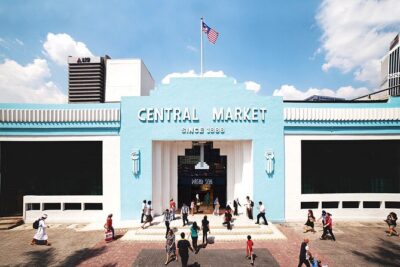
Central Market is the longest stop, at about 30 minutes, and it is a fitting place to finish. The market was first conceived by Kapitan Yap Ah Loy as a modest wet market in 1888. It later became a larger hall of commerce.
This is where the route shifts from administration and colonial institutions toward trade and everyday city life. The market’s origins connect the formal center to the people who bought, sold, and supplied goods.
The end point is especially convenient. You can continue exploring Central Market after the guide leaves, and public transport back to your hotel is described as easy from here. Since the tour does not include a meal, this is also a sensible place to arrange food afterward.
The 30-minute visit is enough to give the market context, but it may not be enough if you want to browse every shop. Plan to return later if you prefer a leisurely look.
What $45 per person really buys you
At $45 per person, the price is easiest to justify when four people share the private experience. The tour includes a personal guide, printed material, admission fees, and 3 to 4 hours focused on Kuala Lumpur’s colonial landmarks.
The fee is not paying for costly entry tickets. The major stops are free. You are paying for the route design, research, interpretation, and the ability to ask questions as you go.
For a couple, the total cost is higher per person than for a full group of four. Still, a private walk can be worthwhile if you care about architecture, city planning, or local history and would rather have a focused conversation than follow a fixed large-group schedule.
Group discounts are available, but the exact reduction is not specified. Meals and bottled water are not included, so carry water and budget separately for food.
Timing, fitness, and practical details
The walk lasts approximately 3 to 4 hours. The advertised stops total close to three hours, but the remaining time allows for movement, explanations, photographs, and the natural pace of a walking tour.
You should have a moderate level of physical fitness. The route covers central Kuala Lumpur on foot, and the heat can make a steady walk feel more demanding than the distance suggests. Wear comfortable shoes and bring water, since bottled water is not supplied.
The meeting point is Kuala Lumpur Railway Station, at 110 Jalan Sultan Hishamuddin. The final stop is Central Market in Kuala Lumpur City Centre. Both locations are near public transport, and the end point makes it simple to continue your day.
Confirmation is provided when you book. The activity is private, and only your own group takes part. Free cancellation is available if you cancel at least 24 hours before the start time. After that cutoff, the amount paid is not refunded, and changes are not accepted.
Who should book this walk
I would choose this tour if you want to understand Kuala Lumpur rather than collect a list of landmarks. It suits people who enjoy architecture, urban history, railway stories, colonial politics, religious buildings, and the small details that make an old district legible.
It also works well for families or friends who want a flexible private outing for up to four people. The walk has enough variety to keep the route from feeling like a single-subject lecture.
I would think twice if you dislike walking in warm weather, want extensive interior access, or prefer a tour built around food and shopping. Central Market is included, but the main focus is history and architecture.
The strongest praise has gone to the guides’ storytelling and the sense that the city center contains far more history than many people expect. That is exactly the promise this walk delivers best: a compact route that makes familiar streets more meaningful.
Should you book the Kuala Lumpur Colonial History Walk?
Book it if you value personal guiding, careful historical context, and a small group. The combination of railway buildings, the river confluence, Jamek Mosque, government offices, churches, banks, public monuments, and Central Market gives you a broad view of how Kuala Lumpur developed.
Skip it if you want a low-cost, self-guided stroll or a tour with included food and drinks. For everyone else, the $45 price can be fair, particularly when shared by four people. Bring water, wear good shoes, and leave extra time at Central Market after the official walk ends.
FAQ
How long does the tour last?
The walking tour lasts approximately 3 to 4 hours.
Where does the tour begin?
It begins at Kuala Lumpur Railway Station, 110 Jalan Sultan Hishamuddin, Kampung Attap, Kuala Lumpur.
Where does the tour end?
It ends at Central Market in Kuala Lumpur City Centre.
Is this a private tour?
Yes. Only your own group participates, with a maximum of four people.
What is included in the price?
The price includes admission fees, printed material, a personalised experience, and the private 3 to 4-hour walking tour.
Are meals included?
No. Meals are not included.
Is bottled water provided?
No. Bottled water is not included, so you should bring your own.
Is the tour near public transportation?
Yes. Both the meeting area and the Central Market ending point are near public transportation.
What level of fitness is required?
You should have a moderate level of physical fitness because the experience is a multi-hour walking tour.
Can I cancel for a full refund?
Yes, if you cancel at least 24 hours before the experience start time. Cancellations made less than 24 hours in advance are not refunded.
More Walking Tours
- Kuala Lumpur Heritage Walk
★ 4.5 · 23 reviews - Kuala Lumpur: Private custom walking tour with a local guide
★ 4.5 · 18 reviews - Kuala Lumpur Heritage 4-Hour Walking Tour
★ 5.0 · 10 reviews - Taman Negara Day Tour with Canopy Walk
★ 5.0 · 9 reviews
More History on the Ground
- From Kuala Lumpur: Private Batu Caves Cultural Tour
★ 4.4 · 410 reviews - Private Half-day Batu Caves and Cultural Tour Kuala Lumpur *2026*
★ 5.0 · 165 reviews - Malacca Historical Private Tour With Personal Chauffeur
★ 4.5 · 151 reviews - Private Half-Day Temples and Cultural Tour in Kuala Lumpur
★ 4.5 · 125 reviews
Just added around Kuala Lumpur
- Historical Melaka Day Tour★ 4.5 · 3 reviews
- AVANI Sepang Goldcoast Resort Hotel To Kuala Lumpur International Airport KLIA KLIA2 Transfer★ 4.5 · 3 reviews
- Best Local Food Tour by Night at Kuala Lumpur★ 3.5 · 3 reviews
- Putrajaya: Wetland Studios Admission Ticket★ 3.9 · 3 reviews
- Sunway lagoon Theme Park★ 4.0 · 3 reviews
- Kuala Lumpur Tour Cruise Excursion from Port Klang★ 5.0 · 3 reviews
- Kuala Lumpur Best Food Tour With A Guide★ 4.5 · 3 reviews
- *10 Hrs Kuala Lumpur Car Tour w’ Tour Guide★ 5.0 · 3 reviews
Historical Tours, compared.
Historical Malacca Guided Day Tour (Shared Tour)
Read our review →
Historical Malacca Day Tour from Kuala Lumpur (Private Tour)
Read our review →
Private Half-day Batu Caves and Cultural Tour Kuala Lumpur *2026*
Read our review →
Malacca Historical Private Tour With Personal Chauffeur
Read our review →Browse the lists this tour appears in